

Baluwatar, Nepal
care@drkishorbhandari.com.np
+977 9843673191

Facial balance plays a quiet but powerful role in how we see ourselves. When patients visit my clinic, they rarely start by saying, “Doctor, I have facial asymmetry.” Instead, they say:
“Why does one side of my jaw look bigger?”
“My chin is shifting to one side.”
“My bite doesn’t feel right.”
“People notice it in photographs.”
These concerns are valid. And more common than you might think.
Let me walk you through what facial asymmetry really means, why it happens, and what we can do about it — in simple, clear terms.
Facial asymmetry simply means that one side of the face looks different from the other.
Now here’s something important: no human face is perfectly symmetrical. If you draw a line down the middle of any face, small differences will always exist. That is completely normal.
The question is not whether asymmetry exists.
The question is: Is it noticeable? Is it progressing? Is it affecting function?
Some asymmetry is subtle and harmless. Other times, it becomes obvious — especially in:
That’s usually when patients seek consultation.
In my practice, many patients come not because of pain, but because they feel something is “off.” They may have noticed it slowly over years, or suddenly after an accident or jaw problem.
And that’s where proper evaluation begins.
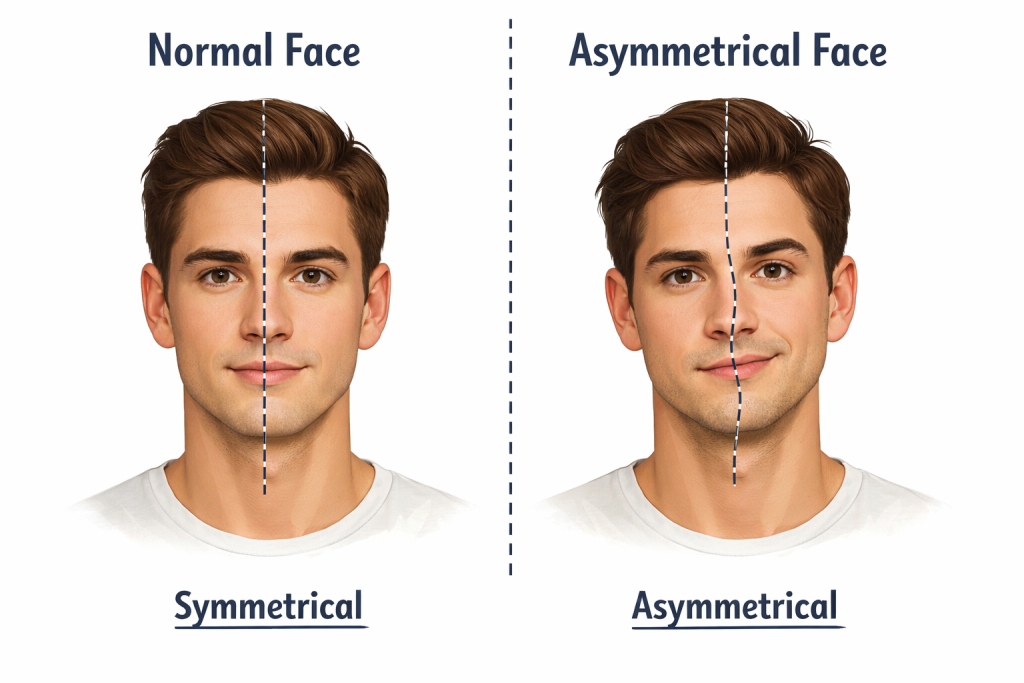
Facial asymmetry does not have one single cause. It can result from growth patterns, joint problems, trauma, or developmental conditions.
Let’s break this down in simple terms.
During childhood and adolescence, the face grows in coordination — upper jaw, lower jaw, joints, and surrounding structures.
Sometimes, one side grows slightly more than the other. In mild cases, it balances out. In other cases, the difference becomes more noticeable over time.
This is especially common during teenage growth spurts.
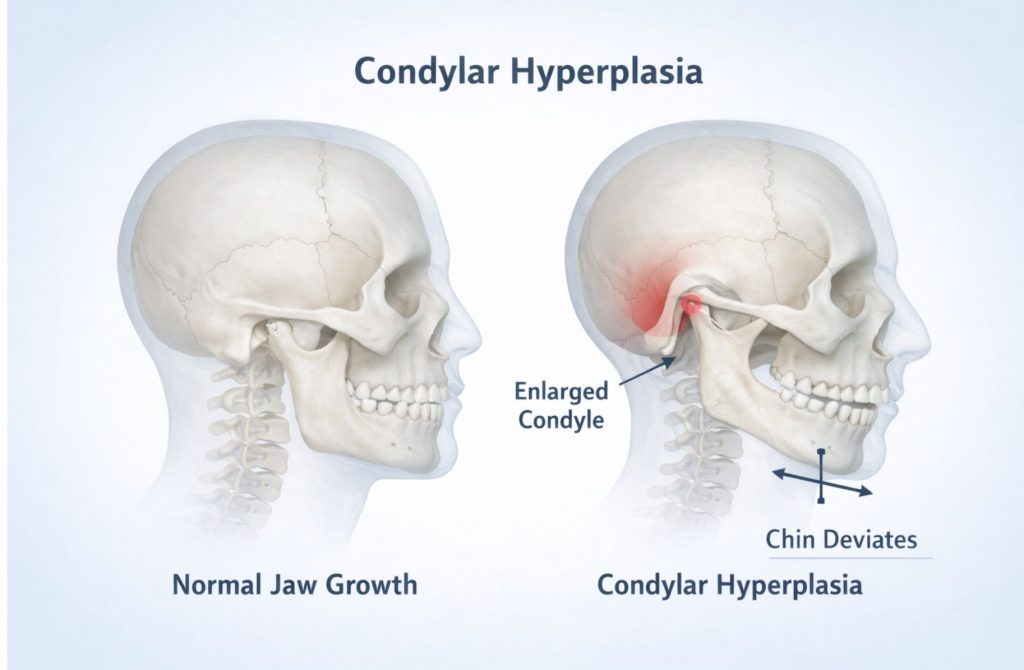
One important cause I often see is Condylar hyperplasia.
Let me explain this in simple language.
The lower jaw (mandible) grows from a region near the ear called the jaw joint (TMJ). The rounded upper part of the lower jaw is called the condyle.
In condylar hyperplasia, one side of this growth center becomes overactive. That means one side of the jaw continues to grow more than the other.
What happens then?
Sometimes the change is gradual. Patients may not notice it until others point it out.
The good news is: once properly diagnosed, we can manage it effectively — especially if detected early.
Facial injuries — especially during childhood — can disturb normal growth.
For example:
When a child’s growth center is damaged, that side may grow less. Over years, this creates asymmetry.
Many adults come to me saying, “I had a fall when I was young. Could that be related?” Often, yes — it can be.

This is another significant cause, particularly in developing countries.
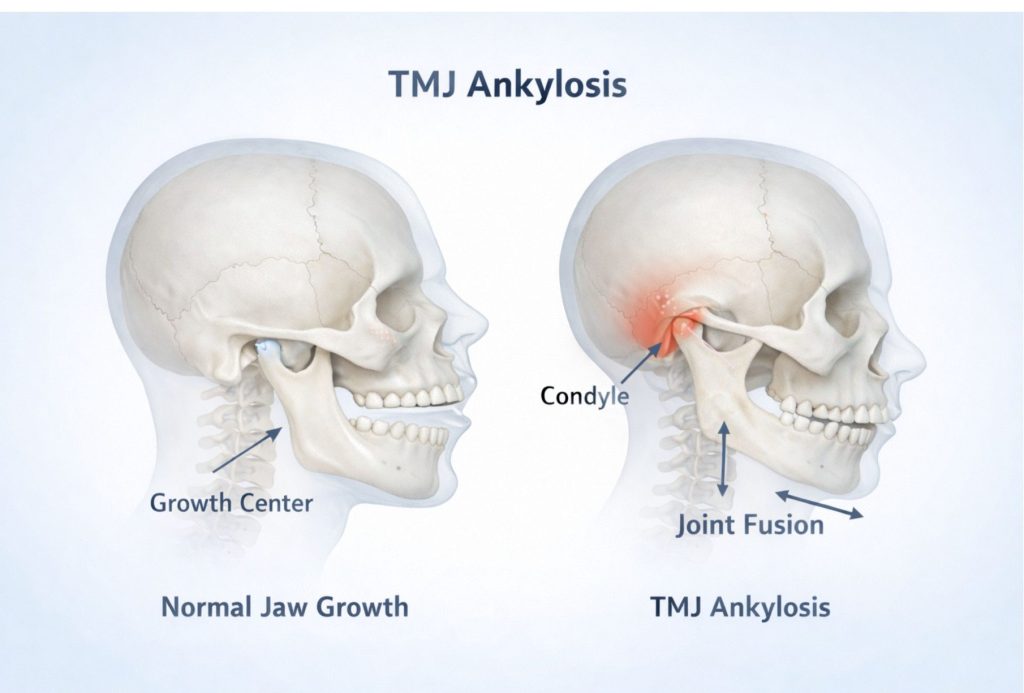
TMJ ankylosis means the jaw joint becomes fused or stuck. Instead of moving freely, it becomes partially or completely immobile.
When this happens in childhood:
Children with untreated TMJ ankylosis often develop severe asymmetry over time.
Early treatment makes a tremendous difference.
Some individuals are born with conditions that affect facial development.
These may involve:
These conditions are present from birth and usually require a multidisciplinary approach.
Severe infections near the jaw joint during childhood can damage the growth center. Though less common today due to antibiotics, it still occurs.
Sometimes there is no obvious trauma or disease. The jaws simply develop unevenly.
The upper jaw may tilt.
The lower jaw may deviate.
Teeth may erupt unevenly.
Not every asymmetry is due to a serious condition. But evaluation is important to understand the reason.
Patients often feel nervous before consultation. Let me reassure you — evaluation is careful, structured, and painless.
Here’s what typically happens.
I begin with observation:
I also gently check jaw joint movement and any tenderness.
This gives us a functional and visual assessment.
Standardized photographs help us analyze:
Photographs are extremely useful for planning and explaining findings to patients.
Modern imaging has transformed diagnosis.
A CBCT scan (3D scan of facial bones) allows us to see:
It gives a precise, three-dimensional understanding of the problem.
In younger patients, we assess whether growth is still active.
This is very important in cases of condylar hyperplasia. If growth is ongoing, timing of treatment changes.
Your bite tells us a lot.
Is one side higher?
Are teeth compensating for jaw shift?
Is there crossbite?
Sometimes the teeth try to “adjust” for jaw asymmetry, hiding the real issue.
Proper diagnosis always looks at both jaws and teeth together.
One of the most common fears I hear is:
“Doctor, will I need surgery?”
The answer depends entirely on the severity and cause.
Treatment is never one-size-fits-all.
Observation
If asymmetry is mild and not progressing, we may simply observe.
Not every asymmetry requires correction.
Sometimes reassurance is the most appropriate treatment.
Braces can correct dental imbalance.
If the issue is primarily tooth-related and skeletal structures are fairly balanced, orthodontic treatment alone may be sufficient.
However, if jaw bones are significantly uneven, braces alone cannot correct the facial shift.
In growing children, we sometimes guide jaw growth using orthopedic appliances.
Early intervention can reduce severity later.
This is why early consultation is valuable.
When jaw bones are significantly misaligned, orthognathic surgery may be required.
This involves repositioning the jaws to achieve balance.
Let me clarify something important:
Orthognathic surgery is not cosmetic surgery.
It is functional and structural correction.
It improves:
In cases of severe jaw asymmetry correction, surgery provides the most predictable results.
Many patients searching for facial asymmetry treatment in Nepal are relieved to know that such advanced treatment is available locally.
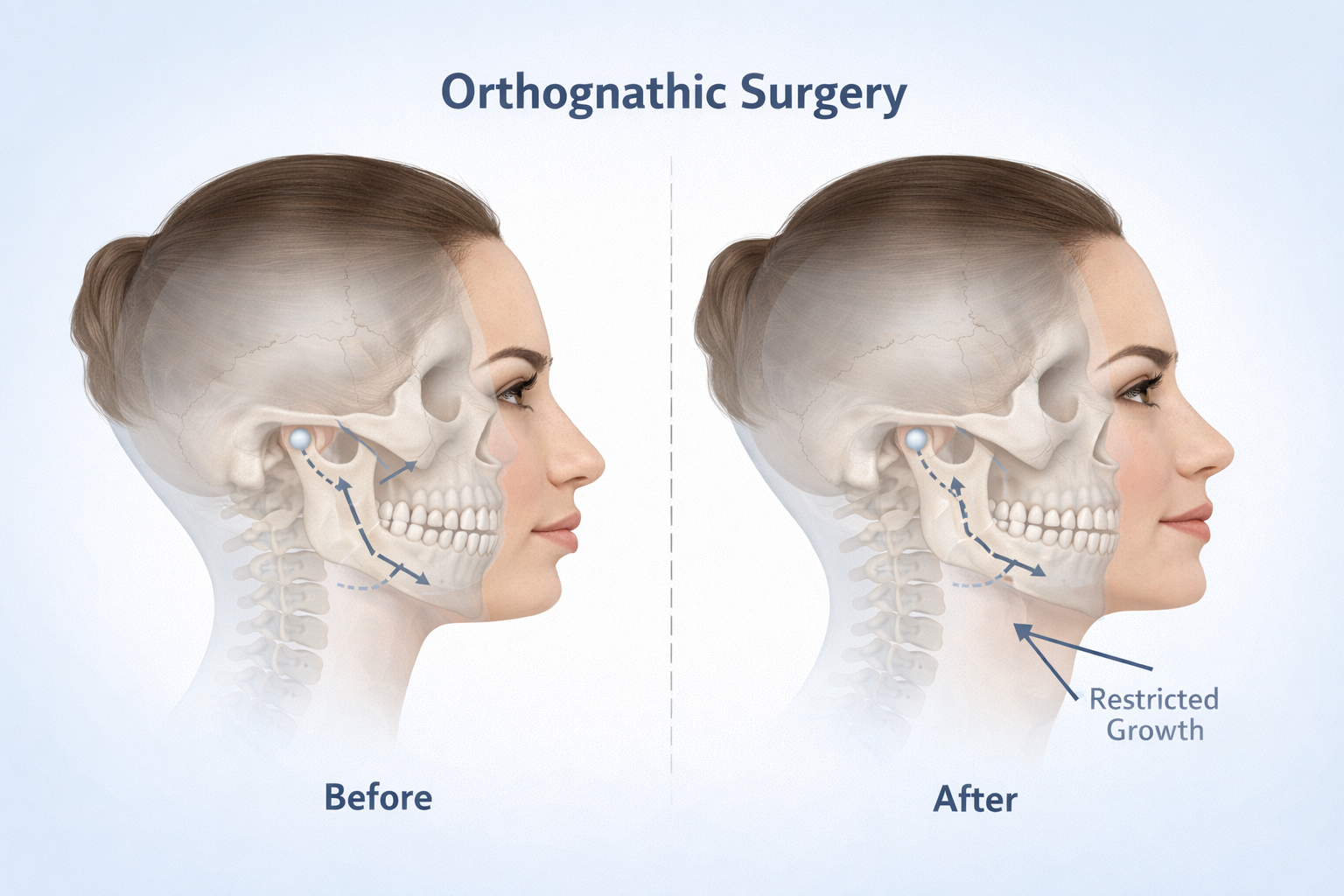
If the problem originates from the jaw joint — such as active condylar hyperplasia or TMJ ankylosis — joint surgery may be required.
This may involve:
The goal is to restore balance and function.
Most moderate to severe asymmetries require a combination of:
Treatment planning is detailed and personalized.
Facial asymmetry is not just about appearance.
It can affect:
Confidence
Patients often avoid photographs.
They tilt their head unconsciously.
They smile less widely.
These subtle behaviors tell me how much it affects them.
Uneven bite can cause:
Asymmetry may overload one side of the jaw joint, leading to discomfort or clicking.
Severe jaw misalignment can affect pronunciation of certain sounds.
I always remind patients:
It’s okay to feel concerned.
You are not being “too conscious.”
These concerns are real and understandable.
If you notice:
It is wise to seek evaluation.
Early consultation allows better planning. In growing patients, it can prevent worsening.
Facial asymmetry treatment in Nepal has evolved significantly. Advanced imaging, careful planning, and modern surgical techniques allow safe and predictable outcomes.
But the most important thing is this:
Every face is unique.
Every treatment plan must be individualized.
In my experience, the best results come from understanding the root cause — not just treating what we see on the surface.
If you are concerned about jaw asymmetry correction, condylar hyperplasia, or TMJ ankylosis, a structured evaluation can give clarity and reassurance.
You do not need to decide anything immediately.
You simply need the right information.
And that is always the first step.
